Read
← Back to IdeasBeyond the Answer Engine: The AI-Era Tensions Reshaping B2B Marketing

In an era where generative AI serves up instant answers to buyers, marketers have become laser focused on the source of the disruption itself, adjusting their B2B marketing playbooks with new letters like AEO and GEO to ensure their brands get found, remembered, and chosen.
And rightly so: treating the pain at the source is the first move. But like the physical therapy that follows a joint replacement, we now need to look at achieving full range of motion. For B2B CMOs, the next step is understanding what buyers need from brands now, and which parts of the old playbook of broadcasting louder and tailoring endlessly no longer serve them.
That means rethinking the B2B playbook around what the buyer needs at each moment toward purchase. Seen that way, five new tensions stand out, from refining the role of AI in your brand narrative, to examining your “next click” experience after an AI answer.
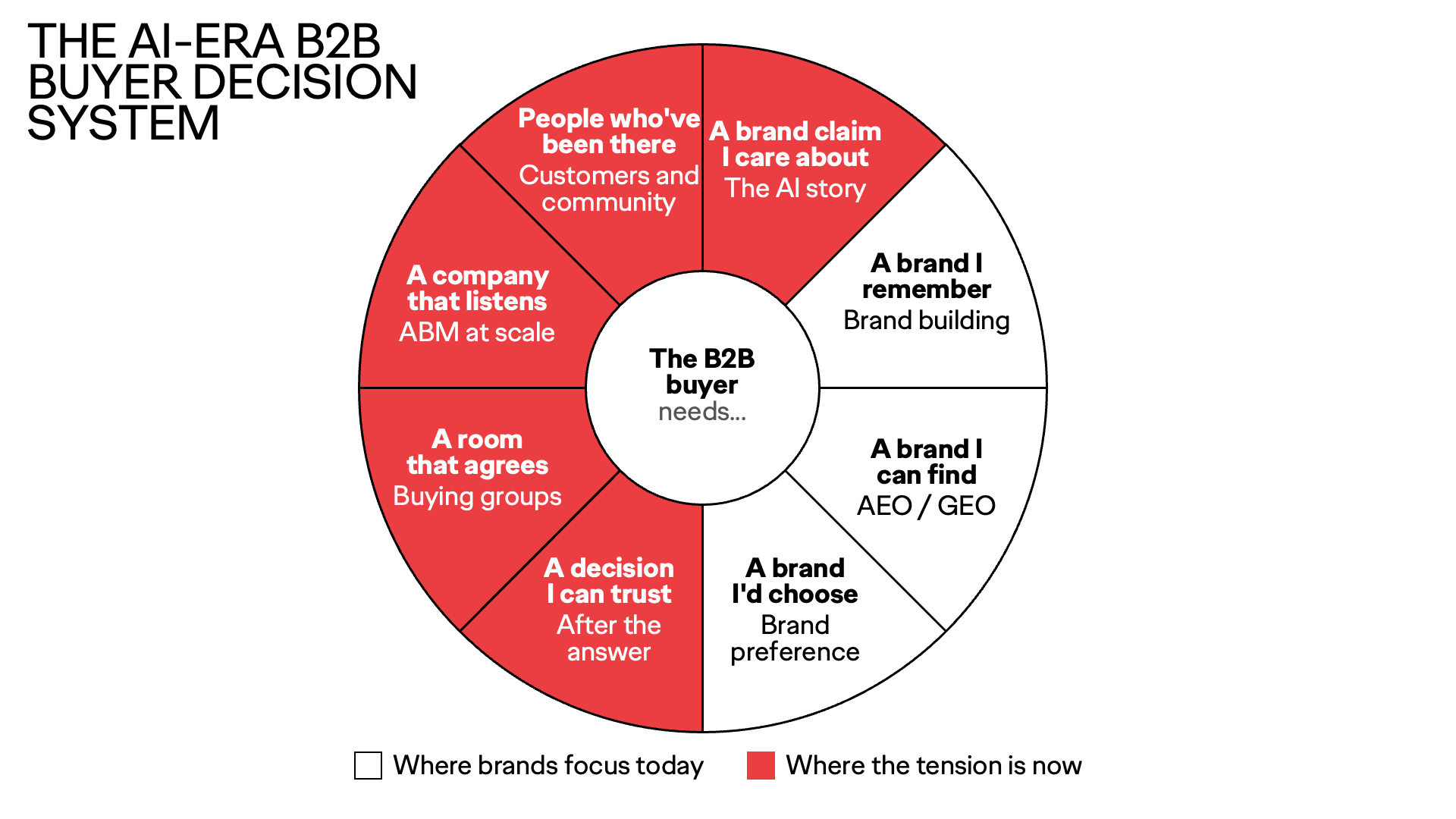
New Tension: AI inside vs. a brand claim I care about
Question to ask: If our buyer has stopped asking if we have AI, why are we still answering it?
Nearly every B2B company is racing to prove it’s in the AI game. In the process, they risk making similar-sounding claims, using the same language, often written by the same tools. Research from LinkedIn’s B2B Institute and Ehrenberg-Bass shows what that buys: 42% of buyers who recalled a GenAI ad remembered only a generic message about AI’s importance, and just 18% recalled a business benefit (2025).
Having AI alone is becoming less of a reason to choose your brand, and more the price of being considered. While AI features are still important, buyers’ questions are moving on: Will it work in our business? What will it take to get there? Can I trust it with my data?
Brands still leading with “we have AI” are answering a question buyers are no longer asking in isolation. The brand narratives that stand out will start where the typical AI claim ends: what changes for the customer, and what it takes to get there.
Where Marketing Leaders Can Start:
- Message: from “we have AI”, to what it changes. Talk about what’s different for the customer, not only what’s under the hood.
- Stance: from capability, to belief. Take a clear position on what AI should and shouldn’t do for your customers. When anyone can copy a capability, a belief can be yours.
- Proof: moving quickly from claims, to experience. Show your difference working in a business like theirs, including what it took and how their data stayed safe.
New Tension: Instant answers vs. a decision I can trust
Question to ask: Now that our brand is in the answer, do we know what our next role is?
Today’s buyers arrive already informed, with “answers” in hand: nearly all business buyers (94%) use AI during their buying process (Forrester, 2026). So like many brands, you may already be working upstream to be top of mind for a problem, and aiming to show up in AEO/GEO share of answer when it arises.
But the brand’s job isn’t done at the answer engine. Fast answers aren’t the same as understanding; buyers with an AI answer still go looking for the brands that can help them make sense of it. We can see it in the 94% of AI-using buyers who fact-check what it tells them, at least some of the time (TrustRadius, 2026).
Yet most brands meet that moment with digital sites and ecosystems caught between the old job of educating buyers and the new job of feeding answer engines. Outreach, events and seller conversations have the same problem: they’re still built to inform people who are already informed.
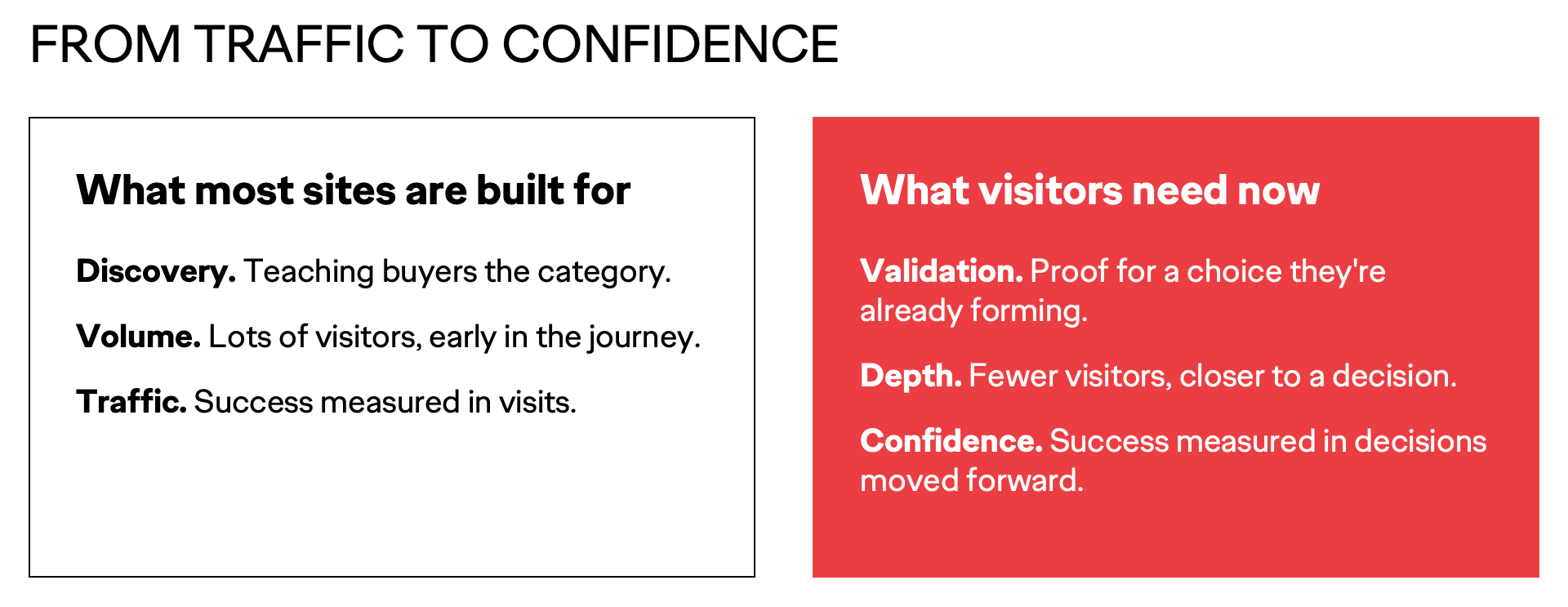
Increasingly, the impact of your brand must not only be felt before and during the answer. As AI hands every buyer a similar answer, the difference becomes how it feels to get from that answer to a decision they can feel confident in. That shift means the role of downstream brand activities must move from simply informing them to a combination of confirming the answers they’ve arrived at, building real understanding, and helping them buy. And the way you do that is a preview of what it’s like to work with you.
Where Marketing Leaders Can Start:
- Website: from answer destination, to understanding space. Buyers come to check what the AI told them against their own situation, not to read more. Diagnostics, benchmarks and business-case tools should replace pages that repeat the answer.
- Sellers: from pitching, to the second opinion. Like a doctor whose patient walks in asking for a pill by name, the seller’s job is to start with “show me what you found,” then pressure test it and make it the right answer for this buyer.
- Events: from the stage, to the table. Nobody travels to a conference for an answer anymore. They come for peers who’ve done it and for time to work through the decision together. That means fewer keynotes and more working sessions and roundtables.
New Tension: Tailored messages vs. a room that agrees
Question to ask: Are we fighting complexity with complexity? Do 20 buyers need 20 messages?
Buying groups, of course, are critical in B2B decision making, yet become tricky to engage as they grow in size and scope each year (73% of purchases now span three or more departments, Forrester, 2026). And it doesn’t help matters that if a purchase includes generative AI features, the buying group doubles in size (Forrester, 2026).
But buyers don’t see the size of their buying group as the problem. 94% of buyers in larger groups say it delivers clear benefits, and fewer than half see added complexity or slower decisions as a real drawback (Forrester, 2026). Often their challenge with the buying group is actually agreement: 74% of buying teams show unhealthy conflict during the decision (Gartner, 2025).
AI makes that agreement harder to reach, and more important. Each person in the room can now arrive with their own answer from their own AI tool, already convinced they’ve done the research. Add a bigger group making a riskier decision, and the brand has to give them a way to land in the same place.
Tailored messaging built to persuade each person can pull your story in different directions, just when the room needs to come together. When the CEO, CFO and CIO each hear a different version of you, you’ve handed them something to argue about. Gartner found that content tailored to individuals had a 59% negative impact on consensus, while content built for the group as a whole improved it by 20%. Groups that reach consensus were also 2.5x more likely to call the deal high quality (Gartner, 2025). Speaking to your audience is important, but trying to be something different to everyone risks standing for nothing the group can agree on.
Brands can meet this head on by starting with a messaging spine built from the brand out: common points every stakeholder can repeat. From there, they can use AI tools to scale delivery of relevant content, experiences, and proof that help the group decide, so the CFO and CIO can ask different questions and still come away with the same answer they can agree on.
Where Marketing Leaders Can Start:
- Audiences: from roles, to fault lines. Plan messaging around the three or four disagreements in the room, not dozens of titles that change by company anyway.
- Messaging: from many messages, to one spine, built from the brand out. Build takeaways every member can repeat in the same words, whoever they are.
- AI: from scaling messages, to scaling consensus-driving content, experiences, and proof. Use AI to adapt the evidence as needed but keep the point fixed.
New Tension: Louder ABM vs. a company that listens
Question to ask: Are we using AI to listen better, or just to talk louder?
Account Based Marketing (ABM) has moved from a niche or ambition, to a part of the standard B2B playbook, as 72% of B2B marketers say they run some form of ABM, up from 46% in 2022 (Visionary Marketing, 2026). Yet most ABM has stayed a program, because doing it well took more people and resources than any company could put on more than a handful of accounts.
That’s harder to live with now, as buyers do more of their research inside AI tools, brands see less of it, and by the time an account raises its hand, its viewpoint may already be formed internally. Meanwhile, those same tools make brand outreach so cheap that every account is about to hear from everyone. So the brands that break through will notice what an account needs early, and respond in a way that shows it.
The easiest move then is for B2B marketers to use AI to churn out more personalized and more frequent account outreach. Instead of an ABM barrage, a better use of AI is to build a brand that listens: one that spots signals, reads them together, and answers each account with one coordinated story, tailored to the account’s situation, not just an individual.
Where Marketing Leaders Can Start:
- Intelligence: from collecting data to listening. AI watches for signals like intent spikes, senior hires and former champions moving, and reads them together to spot a need before the account names it.
- Planning: from product plans to account plays. One cross-product plan per account, built around the account’s situation instead of each team’s calendar.
- Teams: from functions to pods. Marketing, sales and customer success share one account and one plan, so a signal gets a response in hours, not quarters.
New Tension: AI answers vs. real people who’ve been there
Question to ask: When AI can answer anything, who will our buyers believe?
AI can tell a buyer what a solution does, how it compares, and what it should deliver. What it can’t tell them authentically is what it was like to live through it: where it broke down, who had to be convinced, and whether they’d make the same call again. As answers become easier to get, uncovering firsthand experience is getting more valuable.
Peer experiences and case examples have always been a part of B2B buying, as leaders lean on their internal and external networks to justify and de-risk decisions (Forrester, 2026). The same is true today; AI may be where the search starts, but in a big purchase, nobody wants to tell their CFO a chatbot recommended it. They want to have heard from someone who has already made the call and lived with it.
The opportunity for brands now is to move from just publishing proof to opening up access to people, helping buyers get from an AI answer to someone who has actually been there: a peer, a private group, a thread where people say what they really think.
Much of that happens where brands aren’t invited, which is why buyers trust it. The brand’s role now is to know when to host, when to join, and when to stay out of the way. It’s harder than producing a case study, as it can’t be scripted and it won’t always flatter the brand. But the rewards can compound: today’s buyer becomes the person the next buyer trusts, and what they say may even shape the next AI answer.
Where Marketing Leaders Can Start:
- Results: from vendor case studies to customer-owned proof. Agree on what success looks like early, then help customers measure it and tell the story themselves.
- Community: from audiences to peers. Connect buyers with people who’ve made the same decision, including those willing to talk about what went wrong.
- AI: from replacing people to finding them. Use AI to match each buyer with the right customer or expert, not to stand in for them.
Getting into the answer was the first move. Now comes the full range of motion.
AEO and GEO were the right place to start, because brands have to show up in the answer. But that’s where much of the buyer’s work begins: deciding what to believe, working out what the answer means for their business, bringing a room of people along, finding a company that’s paying attention, and hearing from someone who’s been there.
None of these tensions gets solved by producing more. AI makes more easy for everyone, which is exactly why more won’t set anyone apart. What’s harder to copy is how your brand shows up for buyers at each of these moments.
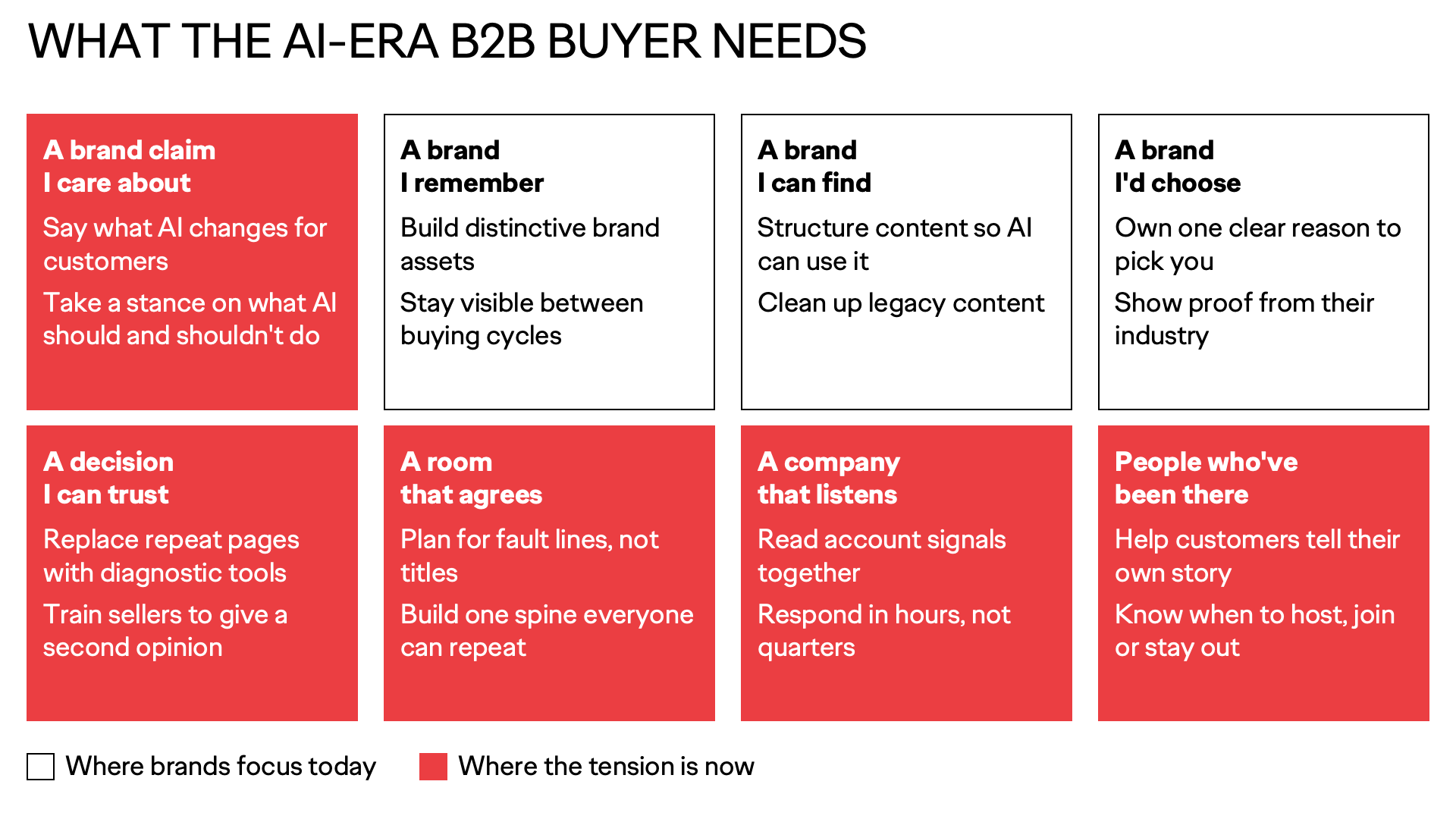
So look across the view below through your buyer’s eyes. Where is your brand strong today, and where does it get stuck? For today’s CMOs, that’s the tension to work on first.
Sources
Forrester, The State of Business Buying, 2026: https://www.forrester.com/blogs/state-of-business-buying-2026
Forrester, The State of Business Buying, 2026 (press release): https://www.forrester.com/press-newsroom/forrester-2026-the-state-of-business-buying/
Forrester, Three Realities About B2B Buying Networks, 2026: https://www.forrester.com/blogs/three-realities-about-b2b-buying-networks/
Digital Commerce 360 on Forrester, 2026: https://digitalcommerce360.com/2026/01/22/forrester-b2b-buying-ai-2026/
Gartner, 74% of B2B Buyer Teams Demonstrate Unhealthy Conflict, 2025: https://www.gartner.com/en/newsroom/press-releases/2025-05-07-gartner-sales-survey-finds-74-percent-of-b2b-buyer-teams-demonstrate-unhealthy-conflict-during-the-decision-process
LinkedIn B2B Institute and Ehrenberg-Bass, How to Win Mindshare in the GenAI Race, 2025: https://business.linkedin.com/advertise/resources/b2b-institute/how-to-win-mindshare-genai-race
TrustRadius, 2026 B2B Buying Disconnect report, via HG Insights: https://hginsights.com/blog/94-percent-of-b2b-buyers-fact-check-ai-research/
Visionary Marketing, Account-Based Marketing Statistics 2026: https://visionary-marketing.co.uk/blog/abm-statistics-202