Read
← Back to IdeasOgilvy unveils inaugural 2026 APAC Believability Index, introducing new believability reputation asset management solutions
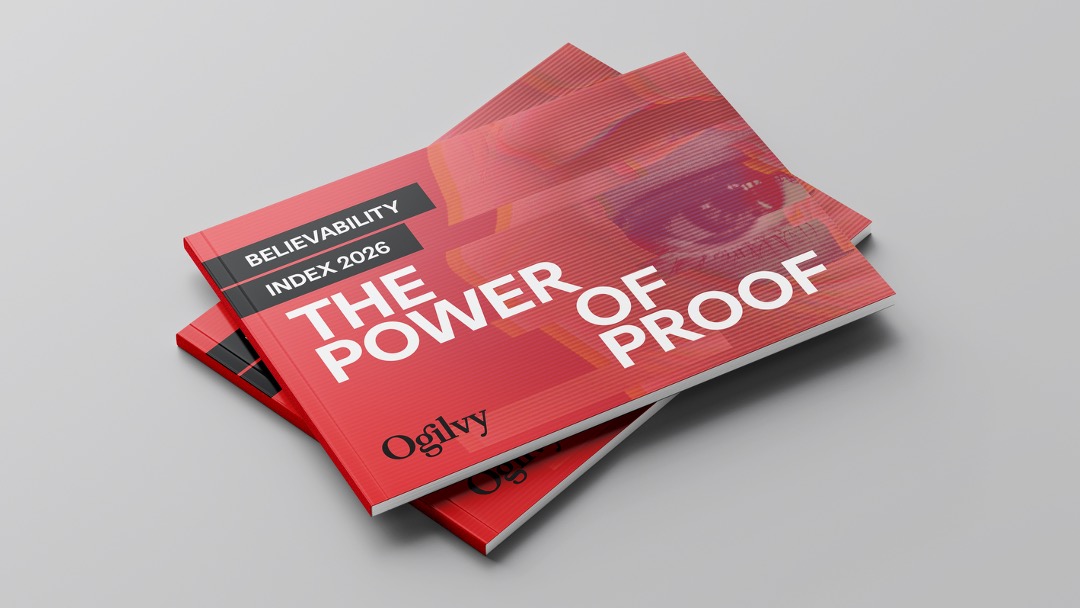
Ogilvy released its first APAC 2026 Believability Index: a comprehensive study examining how consumers across Asia-Pacific determine what and whom they believe in an increasingly complex information environment. Conducted in partnership with YouGov, the research surveyed 7,176 respondents across Asia Pacific markets, including 2,052 from China.
Today, we focus on the China market edition of the research and share key takeaways for this market. For full insights and research, please find the download links at the bottom of this article.
The report reveals that organizations are dangerously overlooking a reputational blind spot that directly impacts revenue: when belief in a brand or organization is lost, consumers most commonly react not by speaking out, but by silently disengaging—or even stopping their purchases entirely. Consumers in China exhibit the most pronounced reactions:
- A staggering 95% choose to quietly disengage when a brand or organization loses its believability, the highest rate in the APAC region
- Up to 80% have stopped engaging with a brand or organization due to a lack of belief in the last 12 months
- Only 14% would publicly share their negative experiences on social media
Joe Yu, President of Ogilvy PR China, noted: "Consumers' 'silent disengagement' directly erodes an organization’s bottom line. Believability is no longer just a communications challenge, but a critical commercial imperative. The true cost of lost belief is now measured in lost revenue, rather than negative headlines. Therefore, we must move beyond surface-level reputation management—such as media monitoring and influencer relations—and fundamentally build and enhance the believability of brands and organizations. "
The research also points to a way forward: building believability by walking the talk; backing words with action and with evidence. A strategy backed by the following findings.
First, making overstated claims and failing to meet expectations are primary triggers for losing believability. In China, the top two drivers of consumer churn are:
- Products or services didn’t deliver on what was promised (47%)
- Exaggerated or misleading brand communications (44%)
Chinese consumers also expect the same alignment of words and actions from corporate executives and spokespeople.
The top two attributes they value most are:
- Integrity (60%)
- Factual correctness (58%)
While making groundless claims and failing to walk the talk leads to a sharp decline in believability, the research also presents a more rational perspective: 89% of Chinese consumers believe that lost belief can be regained. However, they have high expectations for the recovery process, where the key lies in actively correcting or fixing the problem (54%), rather than just publicly acknowledging the mistake.
In an era where "anything can be synthesized," the Chinese market highly trusts institutional authority as the cornerstone of believability. The research shows:
- 73% of Chinese say mainstream media improves their belief in a brand or organization
- 56% place that same trust in official corporate accounts
To help business leaders navigate this shift and translate data insights into action, Ogilvy has concurrently launched a brand-new Believability Solution for reputation asset growth and risk management. This solution consists of four core components. Centered on a behavior-driven approach, it ensures that every brand communication becomes a "trust transaction" that effectively builds believability.
- Action-oriented reputation asset growth solution: Systematically unearthing and integrating a brand's tangible actions in areas like core business operations and ESG, this solution translates corporate strategies and values into visible "action narratives." It breaks away from "empty talk" and "exaggerated" communications, helping organizations continuously accumulate believability capital through everyday, multi-perspective messaging, ensuring every communication acts as an effective deposit into their reputation asset.
- Leaning into trusted sources for high-trust communication matrices: We build proprietary frameworks for brands and organizations to ensure they communicate through the channels consumers trust most. This uses mainstream media and official corporate accounts as the primary believability foundation, layered with a targeted influencer/KOL strategy and social validation mechanisms, to effectively enhance information credibility.
- Believability diagnostic AI tool: Powered by Ogilvy's enterprise-grade AI agent and utilizing a multi-agent architecture, this tool pairs Ogilvy’s proprietary Believability dataset with a behavioral science cognitive engine to quantitatively measure a brand's "Say-Do Gap." By calculating a brand's "Believability Elasticity" (the critical threshold for consumer churn) and providing actionable improvement plans, the tool helps leaders predict and prevent silent customer churn before it impacts the bottom line.
- Action-oriented risk prevention and management: Based on Ogilvy's 4R Crisis Management System, we build an action-led "proof-of-change" narrative for brands and organizations. This emphasizes problem-solving messages, showcases systemic organizational improvements, and develops long-term, transparent communication roadmaps, helping enterprises respond to public concerns with authentic actions and fundamentally win back believability.
Please download the reports here:
1. 2026 Ogilvy APAC Believability Index - China Market Edition (English Version)
2. 2026 Ogilvy APAC Believability Index - APAC Edition (English Version)